You’re standing in the gun aisle, and the decision feels heavy. 12 gauge or 20 gauge? Both have loyal followings. But when it comes to protecting your family, you need the right tool for the job. We’re here to help you decide.
In this guide, we break down recoil, stopping power, ammunition cost, maneuverability, and ease of use. We’ll look at real data and give you straight talk so you can choose with confidence. Whether you’re a first-time buyer or a seasoned shooter, we’ve got you covered.
Recoil and Controllability
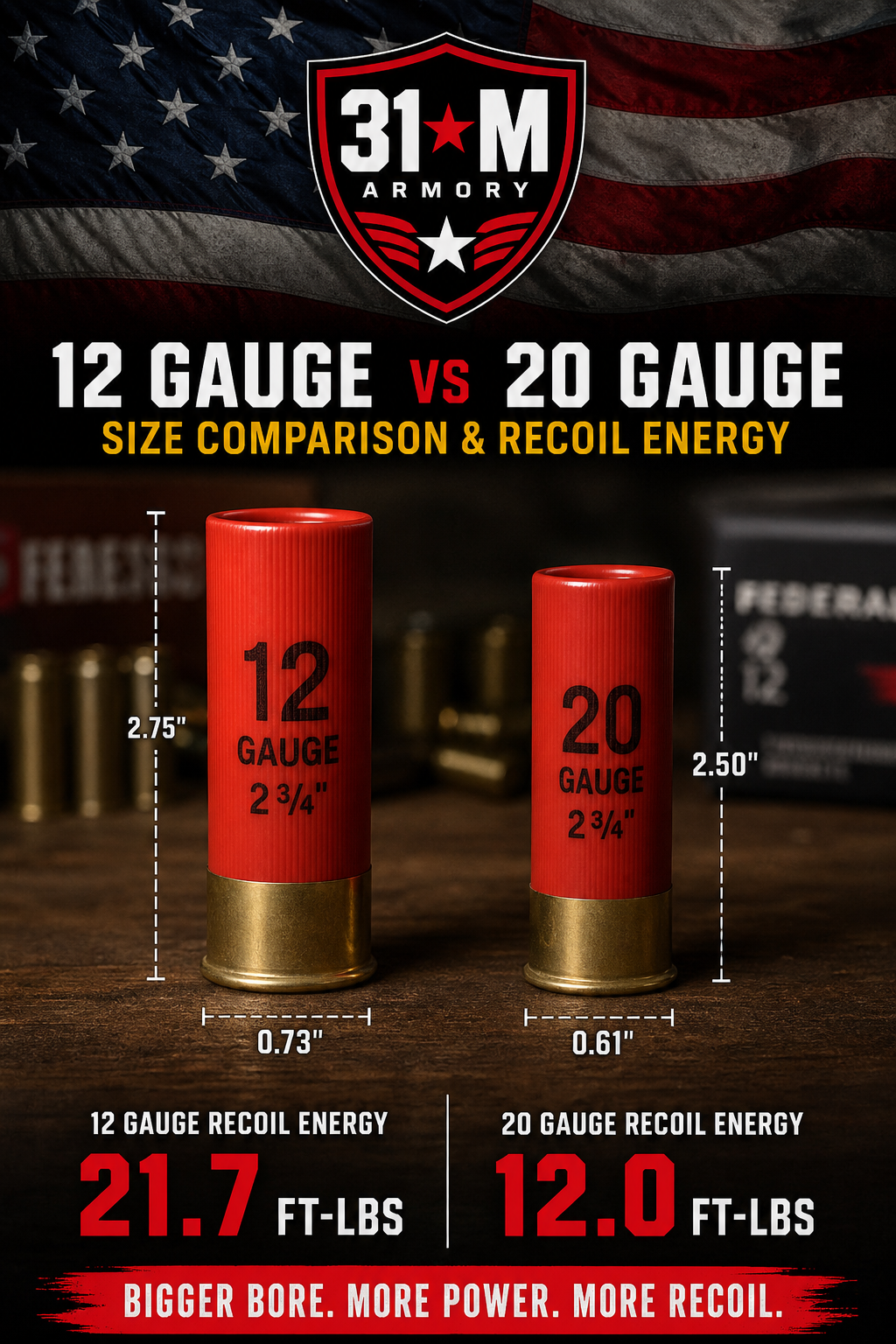
Recoil is the number one reason people shy away from shotguns. A 12-gauge can kick hard. The numbers back that up. According to Pew Pew Tactical, 12-gauge recoil ranges from 11 to 31 ft-lbs. That’s a wide spread. A 20-gauge typically starts around 17 ft-lbs and goes up from there. But here’s the thing: some 12-gauge loads actually recoil less than a typical 20-gauge load. It’s not as simple as “bigger gauge equals more kick.”
For home defense, controllability is everything. If you can’t get follow-up shots on target, it doesn’t matter how much power you have. A 20-gauge shotgun is lighter and generally produces less felt recoil. That makes it easier for smaller shooters, newer shooters, or anyone who doesn’t want to practice with a cannon. We’ve seen too many people buy a 12-gauge, shoot it once, and then never practice again. That’s dangerous.
But don’t count the 12-gauge out. With low-recoil tactical loads, you can get 12-gauge power without the worst of the kick. Brands like Federal offer FliteControl buckshot that patterns tight and recoils less. The key is to try before you buy. Visit a range that rents both gauges. Shoot them side by side. That’s the only way to know what works for you.
“The best gauge for home defense is the one you can shoot accurately and quickly.”
Bottom line: If recoil is a major concern, a 20-gauge offers a more manageable kick without sacrificing too much power, but modern 12-gauge low-recoil loads can level the playing field.
Stopping Power and Effectiveness
Stopping power matters. A 12-gauge with 00 buckshot delivers nine .33-caliber pellets at around 1,200 feet per second. That’s a lot of lead on target. But the 20-gauge is no slouch. According to data from Pew Pew Tactical, a 20-gauge round averages 1,335 ft-lbs of muzzle energy. That’s actually above the average of 1,294 ft-lbs for all gauges sampled. So the 20-gauge punches harder than many people think.
In home defense, you’re likely shooting at close range , inside 20 yards. Both gauges will put multiple pellets into a threat. The 12-gauge can hold more pellets per shell (9 pellets of 00 buck vs 8-9 pellets of #1 or #3 buck in 20-gauge). But those smaller pellets in the 20-gauge can still penetrate deep enough to reach vital organs. The NRA Family reports that 20-gauge buckshot loads reliably penetrate 12-18 inches in ballistic gel, which is the FBI’s standard.
| Factor | 12 Gauge | 20 Gauge |
|---|---|---|
| Common Buckshot Pellets | 9 (00 buck) | 8-9 (#1 or #3 buck) |
| Average Muzzle Energy | 1,694 ft-lbs (00 buck) | 1,335 ft-lbs |
| Pellet Diameter | .33 inches (00) | .25-.30 inches (#1/#3) |
| Effective Range (buckshot) | 25-30 yards | 20-25 yards |
Some argue that 12-gauge is the only choice because of its proven track record with law enforcement. But military and police use 12-gauge because they need to defeat barriers and engage at longer ranges. For home defense, you’re not shooting through walls or across a field. You’re stopping a threat in your living room. The 20-gauge has plenty of power for that job.
Bottom line: Both gauges can stop an intruder effectively, but the 12-gauge offers a slight edge in raw pellet count and energy, while the 20-gauge is more than adequate for close-range defense.
Ammunition Capacity and Cost
Ammunition availability matters. 12-gauge is everywhere. You can find it at any Walmart, gun shop, or online retailer. 20-gauge is also common, but the selection of defensive loads is thinner. Most stores carry 12-gauge 00 buckshot from multiple brands. For 20-gauge, you might only find one or two options. That’s changing slowly. Federal introduced a FliteControl load for 20-gauge at SHOT Show 2024, which is a step in the right direction.
Cost-wise, 12-gauge defensive ammo is generally cheaper per round because it’s produced in higher volume. You can expect to pay $1-$2 per round for premium 12-gauge buckshot. 20-gauge often costs the same or slightly more, despite having less material. That’s the economics of scale. For practice, 12-gauge birdshot is dirt cheap. 20-gauge birdshot is also affordable, but again, fewer options.
Capacity is another factor. Most pump-action shotguns in 12-gauge hold 5+1 or 6+1 rounds. 20-gauge models often have similar capacities, though some manufacturers offer extended tubes. The 20-gauge shell is smaller, so you can sometimes fit more rounds in the same length magazine tube. But in practice, the difference is usually one or two shells. Nothing that will make or break a defense scenario.
Bottom line: 12-gauge offers more ammunition choices and slightly lower cost, but 20-gauge is still widely available and affordable for home defense.
Maneuverability and Weight
Home defense often happens in tight spaces: hallways, doorways, bedrooms. A long, heavy shotgun can be a liability. 20-gauge shotguns are typically lighter and smaller. A typical 20-gauge pump-action weighs about 6.5 pounds, while a comparable 12-gauge might be 7.5 pounds. That pound might not seem like much, but when you’re moving quickly, it matters.
Barrel length is another factor. Most home defense shotguns come with 18.5-inch barrels. Both gauges offer that length, but 20-gauge guns often have slightly shorter overall length because the receiver is smaller. That can make them easier to maneuver in close quarters. And for shooters with smaller frames, a lighter gun is easier to control and hold steady.

But weight isn’t everything. Some shooters prefer a heavier 12-gauge because it soaks up recoil. A heavier gun moves less when you fire, so follow-ups can be faster. It’s a trade-off. For smaller shooters, the 20-gauge’s lighter weight is a clear advantage. For larger shooters, the 12-gauge’s weight might actually help.
on Top Home Defense Weapons for 2026 for more comparisons.
Bottom line: The 20-gauge’s lighter weight and smaller size make it easier to handle in tight spaces, but some shooters may prefer the recoil-damping weight of a 12-gauge.
Ease of Use for Home Defense
A home defense gun has to be simple to operate under stress. Pump-action shotguns are reliable but require manual cycling. Semi-autos are faster but can be picky with ammo. Both 12-gauge and 20-gauge come in pump and semi-auto versions. The 12-gauge has more options in the semi-auto category, which is important if you want to minimize recoil and maximize speed.
But the 20-gauge has a secret advantage: it’s often easier to shoot accurately. Because of less recoil and muzzle rise, you can stay on target for multiple shots. That’s critical in a defensive scenario. Many first-time shooters find the 20-gauge less intimidating, which means they practice more. And practice is what makes you effective.
Another consideration is the sound. Racking a pump-action shotgun is a universally recognized sound. Some people say that sound alone can deter an intruder. That’s true for both gauges. But if you ever have to fire, a 20-gauge is slightly quieter (still extremely loud, but less so). In the enclosed space of a home, the blast from a 12-gauge can be disorienting. The 20-gauge is a bit more forgiving on the ears, though you’ll still want ear protection during practice.
“The sound of a pump-action shotgun being racked is a universal language.”
For a deeper look at ammunition choices, on Top Shotgun Shells for Home Defense 2026 Guide.
Bottom line: The 20-gauge is often easier to shoot accurately for beginners and those sensitive to recoil, while the 12-gauge offers a wider range of firearms and ammunition.
Frequently Asked Questions
Which gauge has less recoil, 12 or 20?
The 20-gauge generally has less recoil than a 12-gauge when comparing standard loads. However, some 12-gauge low-recoil loads produce less kick than standard 20-gauge buckshot. The average 20-gauge recoil is around 17 ft-lbs, while 12-gauge can range from 11 to 31 ft-lbs. For most shooters, the 20-gauge is more pleasant to shoot.
Can a 20-gauge stop an intruder?
Yes, absolutely. A 20-gauge loaded with buckshot delivers multiple pellets with enough energy to penetrate deeply and cause severe injury. The 20-gauge’s muzzle energy averages 1,335 ft-lbs, which is more than enough for close-range defense. Many hunters use 20-gauge to take down deer and hogs, which are tougher than humans.
Is 12 gauge too powerful for home defense?
Not necessarily. The 12-gauge is very effective, but its power can lead to overpenetration through walls, which is a concern if you have family members in other rooms. Using the right ammunition (like #4 buckshot) can reduce this risk. The 12-gauge is used by police and military, but those users often have different training and scenarios.
What is the best 12 gauge vs 20 gauge for home defense for a woman?
Many women prefer the 20-gauge because it is lighter and has less recoil, making it easier to handle and practice with. However, it depends on the individual’s strength and comfort. The key is to try both and see which one you can shoot accurately and comfortably. A 20-gauge with a youth stock can also fit smaller frames better.
How does ammunition cost compare between 12 and 20 gauge?
12-gauge ammunition is generally cheaper per round because of higher production volume. For target practice, 12-gauge birdshot can be found for around $0.30 per round, while 20-gauge is often $0.40-$0.50. Defensive loads are similar in price, with 12-gauge sometimes being a few cents cheaper. Overall, the difference is minor.
Can you use a 20 gauge for home defense if you also hunt?
Yes, a 20-gauge is a versatile choice for both home defense and hunting. It’s popular for upland bird hunting and small game. For waterfowl, you might want a 12-gauge for heavier loads, but a 20-gauge with steel shot works fine. Many hunters choose 20-gauge for its lighter weight in the field.
What is the effective range of a 20 gauge for home defense?
For home defense, the effective range of a 20-gauge with buckshot is typically 20-25 yards. Inside a home, shots are usually under 10 yards, so that’s more than enough. The 20-gauge pattern will stay tight enough to deliver several pellets on target at those distances. Slugs can extend range, but are not recommended for home defense due to overpenetration.
Are there more accessories for 12 gauge shotguns?
Yes, because the 12-gauge is more popular, there are more aftermarket accessories: stocks, forends, sights, lights, and shell carriers. However, the 20-gauge market is growing, and many accessories like lights and slings are universal. For specialized parts like barrels or magazine tubes, 12-gauge has more options.
Conclusion
So, 12 gauge vs 20 gauge for home defense: which one should you pick? The answer comes down to you. We at 31 M Armory believe the best shotgun is the one you’ll practice with and use confidently. The 12-gauge offers raw power and the widest selection of guns and ammo. The 20-gauge offers a lighter, more controllable package that still delivers enough stopping power for any home invasion.
If you’re a bigger shooter who doesn’t mind recoil and wants maximum versatility, go 12-gauge. If you’re smaller, newer to shooting, or just want a gun that’s easy to handle, go 20-gauge. You can’t go wrong either way. Both are proven home defense tools. The key is to train, train, train.
We’re proud to serve veterans and all law-abiding firearm enthusiasts. As a veteran-owned business, we offer a 6% discount to all veterans. We stock both 12-gauge and 20-gauge shotguns and ammunition. Browse our selection at 31m-armory.com and find the perfect home defense shotgun for your family. Your safety is worth it.
For more home defense advice, s on Home Defense AR-15: A Step‑by‑Step Guide 2026 and Best 9mm for Self Defense: Top Picks for 2026. And remember, knowing how to use your firearm is just as important as owning one. Stay safe and stay prepared.