So you’re stuck between two of the most popular rifle cartridges out there. The 6.5 Creedmoor vs 308 Winchester debate has been going on for years. And honestly, there’s no single right answer. It depends on what you want to do. Shoot targets at long range? Hunt deer or elk? Maybe both?
We’re going to break down every angle. Ballistics, recoil, barrel life, hunting performance, cost, and specialized uses like PRS competition. By the end, you’ll know exactly which round belongs in your safe.
We’re 31 M Armory, a veteran owned retailer. We carry both calibers. And we’re here to help you pick the right one for your needs.
Ballistic Performance: Trajectory, Drop, and Wind Drift
Let’s start with the numbers. The 6.5 Creedmoor was designed by Hornady in 2008 for long-range target shooting. It uses a smaller bullet with a high ballistic coefficient. The .308 Winchester has been around since the 1950s and is a proven military and hunting round.
At the muzzle, the .308 hits harder. For example, Federal’s 165-grain Trophy Copper .308 Win produces 2,671 ft-lbs of energy. The 120-grain 6.5 Creedmoor version gives 2,200 ft-lbs. That’s about a 400 ft-lb advantage for the .308 at the barrel.
But things change downrange. The 6.5’s high-BC bullets (like the Hornady 140gr A-MAX with a BC of .585) hold velocity much better. According to M*CARBO’s ballistic charts, at 1,000 yards the 6.5 Creedmoor has about 110 inches less drop than the .308 Winchester. In a 10 mph crosswind, the 6.5 drifts about 13 inches less. That’s a huge advantage for long-range work.
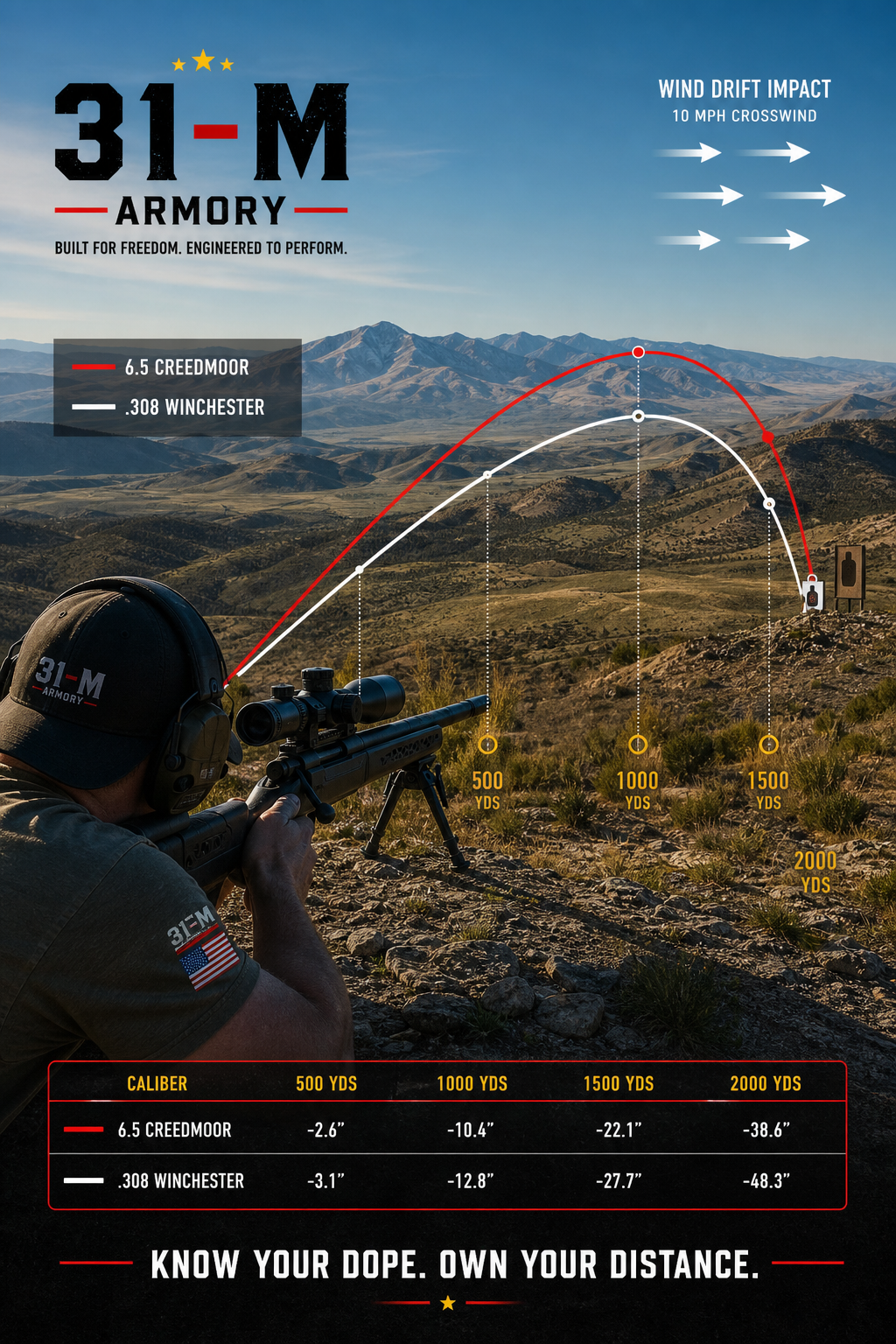
In practical terms, the 6.5 stays supersonic past 1,200 yards. The .308 goes transonic around 800-900 yards depending on the load. That means the 6.5 is more predictable at extreme distances.
But let’s be honest. Most hunters shoot under 400 yards. Inside that distance, the .308’s energy advantage is real. You get a heavier bullet with more knockdown power. For target shooters reaching past 500, the 6.5 is the clear winner.
Bottom line:If you shoot past 500 yards, choose the 6.5 Creedmoor for less drop and wind drift; for short-range power, the .308 Winchester still holds the edge.
Recoil Comparison and Shooter Comfort
Recoil matters. It affects accuracy, follow-up shots, and how much fun you have at the range. The 6.5 Creedmoor produces about 25-30% less recoil than the .308 Winchester. That’s a big deal.
According to Silencer Central, a typical 6.5 Creedmoor load generates around 12-15 ft-lbs of free recoil, while a .308 Win pushes 18-22 ft-lbs. That’s a noticeable difference, especially when shooting from a bench or in hunting positions where you can’t brace well.
Less recoil means you flinch less. You stay on target for follow-up shots. This is critical in competition like PRS, where you might need to engage multiple targets quickly. New shooters and youth hunters also benefit hugely from the reduced kick.
The .308 isn’t a shoulder-breaker by any means. It’s manageable. But the difference is real. Many shooters switch to 6.5 just for this reason.
Both cartridges work well with suppressors. In fact, the 6.5 tends to sound a little quieter to the shooter due to lower pressure, though that varies by load.
Bottom line:For less recoil and faster follow-ups, pick the 6.5 Creedmoor; if you can handle a bit more kick, the .308 is fine.
Barrel Life and Maintenance Considerations
No one wants to replace a barrel every year. Barrel life depends on pressure, heat, and how often you clean. The .308 Winchester generally lasts longer because it runs at lower pressures and slower velocities.
Typical barrel life for a .308 shooting full-power loads is 5,000 to 10,000 rounds before accuracy starts to drop. For the 6.5 Creedmoor, it’s more like 3,000 to 5,000 rounds. The 6.5 burns hotter and erodes the throat faster. That’s the price you pay for higher velocity and better ballistics.
According to discussions on Sniper’s Hide, many competitive shooters report getting 3,000-4,000 accurate rounds from a 6.5 Creedmoor barrel, then it starts to fade. .308 barrels often go 6,000-8,000 rounds before opening up.
But barrel life isn’t just about round count. How you shoot matters. Slow fire, letting the barrel cool, and regular cleaning (but not over-cleaning) extend life. Hot barrel after hot barrel in a match will wear it faster.
If you’re a high-volume shooter or plan to shoot thousands of rounds a year, the .308 might save you money on barrel replacements. For occasional shooters or hunters, barrel life is less of a concern.
Bottom line:Choose the .308 if you want a barrel that lasts thousands more rounds; the 6.5 Creedmoor costs you more in barrel wear but gives superior ballistics.
Hunting Suitability: Effective Range and Ethical Kill Distance
Hunters care about one thing: putting meat in the freezer. Both calibers are capable, but they shine in different scenarios.
The .308 Winchester has a proven track record on big game. It’s been used for deer, elk, moose, and even bear for decades. Heavier bullets (150-180 grains) deliver deep penetration and good energy transfer. At typical hunting ranges under 300 yards, the .308 hits hard and puts animals down fast.
The 6.5 Creedmoor is lighter recoiling and flatter shooting. It’s excellent for deer and antelope at longer ranges. Many hunters, including the MeatEater crew, have taken elk with 140-147 grain 6.5 bullets. Terminal performance is good, but you need to place shots carefully. The 6.5 doesn’t have the same margin for error as a .308 on large game.
According to MeatEater’s caliber battle, the .308 holds a muzzle energy advantage of about 400 ft-lbs over the 6.5. But at 400 yards, that gap shrinks to only 189 ft-lbs. At 800 yards, the 6.5 actually has slightly more energy. For most ethical hunters, shots beyond 400 yards are rare. Inside that, the .308 is the king.
Wind is another factor. The 6.5 Creedmoor bucks wind better, which matters if you hunt open country. On a windy day at 500 yards, the 6.5 will drift less, making it easier to hit vitals.
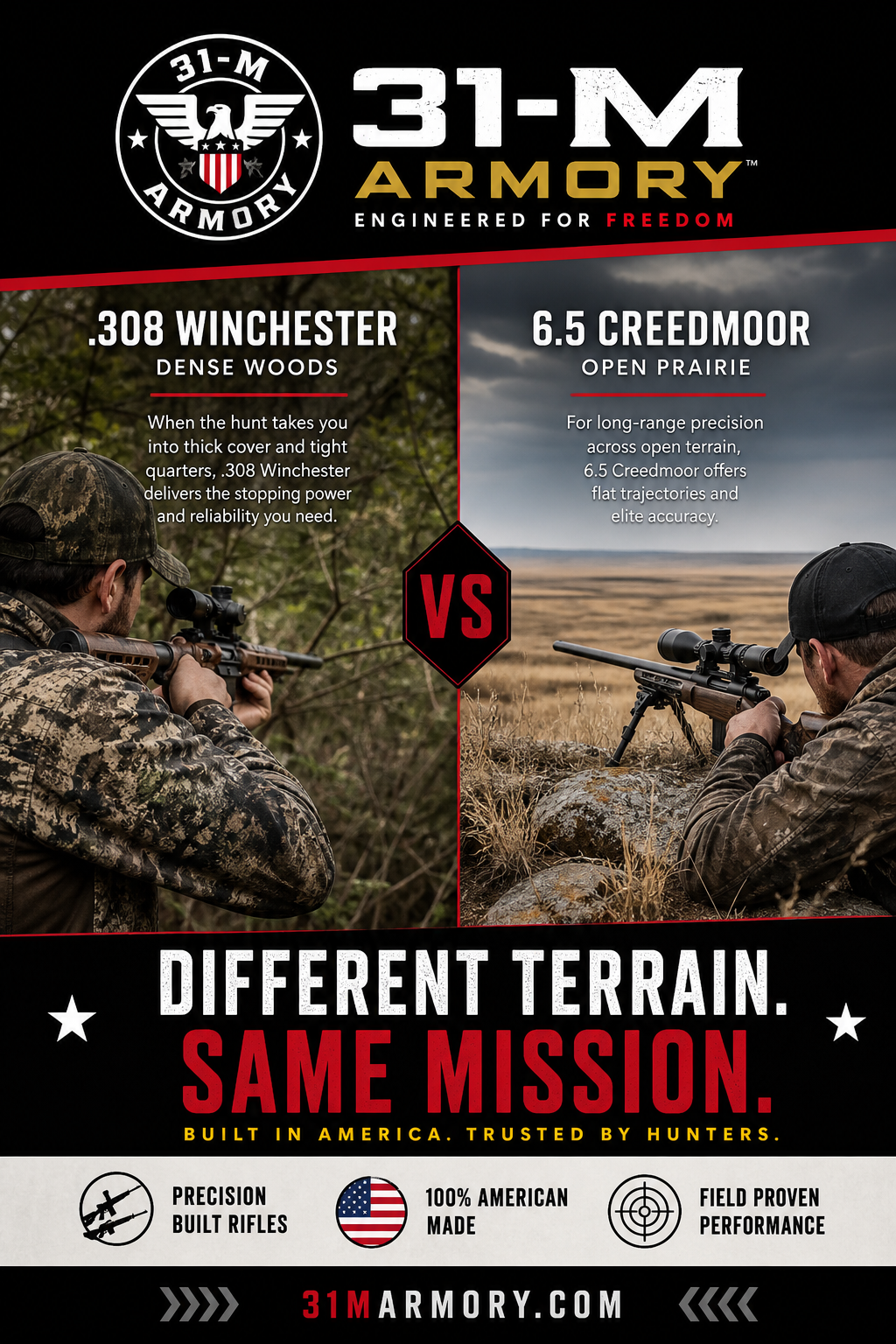
“If you’re hunting in thick woods where shots are under 200 yards, the .308 is hard to beat. If you’re on a prairie or mountain, the 6.5 gives you more reach.”
For deer hunting, both the 6.5 Creedmoor and .308 are excellent choices — check out our guide on the best deer hunting caliber for top picks. For predators like coyotes, the 6.5 is great because it doesn’t destroy hides. For varmints, both work, but lighter .308 bullets are available.
Bottom line:For ethical kills under 400 yards, the .308 has the edge; for extending your range beyond that, go with the 6.5 Creedmoor.
Ammo Cost, Availability, and Reloading Value
Cost per round adds up fast if you shoot a lot. The .308 Winchester is generally cheaper and more widely available. You can find it at any sporting goods store, often for under $1 per round for surplus or plinking ammo. Hunting ammo runs $1.50-$2.50 per round.
The 6.5 Creedmoor is more expensive. Plinking ammo starts around $1.10-$1.40, and premium hunting loads can be $2.00-$3.00. Availability is good online, but you won’t always find it on rural shelves.
During ammo shortages, .308 tends to come back in stock faster due to NATO contracts. But 6.5 has become popular enough that it’s usually available too.
Reloading changes the picture. Both calibers are easy to reload, but the 6.5 Creedmoor uses less powder per round (around 40-43 grains vs 45-50 for .308). That saves money. Also, 6.5 bullets like the 140gr ELD-M are high quality but not crazy expensive. You can reload 6.5 for about the same cost as .308, or even a little less.
| Factor | .308 Winchester | 6.5 Creedmoor |
|---|---|---|
| Cheapest plinking ammo (per round) | $0.80 – $1.00 | $1.10 – $1.40 |
| Hunting ammo (per round) | $1.50 – $2.50 | $2.00 – $3.00 |
| Reloading cost per round (estimate) | $0.60 – $0.90 | $0.50 – $0.80 |
| Powder charge per round | ~45-50 gr | ~40-43 gr |
| Bullet selection | Very wide (110-200gr) | Good (90-147gr) |
If you buy factory ammo, .308 is cheaper and easier to find. If you reload, the cost gap narrows, and the 6.5 Creedmoor can even be slightly cheaper per shot.
Bottom line:If you shoot factory ammo, .308 saves you money; if you reload, the 6.5 Creedmoor is just as economical and gives better performance.
Specialized Use Cases: PRS, Tactical, and Long-Range Precision
In precision rifle shooting, the 6.5 Creedmoor dominates. Major PRS matches see over 80% of shooters using 6.5 Creedmoor. Why? Because it shoots flatter, drifts less in wind, and has less recoil for fast follow-ups. The .308 is a distant second, mostly used in tactical classes or by those who haven’t switched yet.
For tactical and law enforcement, the .308 has a longer service history. It’s proven in battle. But the 6.5 Creedmoor is increasingly used by snipers for its long-range capability. The U.S. military has adopted 6.5 Creedmoor for some units (e.g., the Marines’ M40A7). However, .308 remains common for urban operations where ranges are shorter and barrier penetration matters.
As seen in videos like Banana Ballistics’ barrier test, the 6.5 Creedmoor and .308 perform similarly through wood, sand, and concrete. The 6.5 tends to slip through barriers a bit better due to smaller diameter, but the .308 delivers more energy on impact.
For hunting from a stand or blind, either works. For mountain hunting where you carry the rifle all day, the 6.5’s lighter ammo weight (by a few ounces per box) adds up. Also, 6.5 Creedmoor rifles often have lighter profiles.
If you’re building an AR-10, both calibers are popular. The .308 has a slight edge in parts availability, but 6.5 Creedmoor AR-10s are common now.
Bottom line:Choose 6.5 Creedmoor for competition and long-range target shooting; choose .308 for proven tactical reliability and close-range versatility.
Frequently Asked Questions
Which has more recoil, 6.5 Creedmoor or 308?
The .308 Winchester has about 25-30% more recoil than the 6.5 Creedmoor. That means the 6.5 is noticeably softer shooting, making it a better choice for new shooters, youth, or anyone who wants less fatigue during long range sessions. However, both are manageable with proper form.
Is 6.5 Creedmoor better than 308 for long range?
Yes, for distances beyond 500 yards, the 6.5 Creedmoor has clear advantages: less bullet drop, less wind drift, and it stays supersonic past 1,000 yards. The .308 is more challenging at extreme range due to higher drop and drift. For target shooting past 600 yards, the 6.5 is superior.
Can 6.5 Creedmoor kill elk?
Absolutely. The 6.5 Creedmoor has taken many elk with proper shot placement and the right bullet (like 140-147 grain bonded or monolithic bullets). It lacks the margin for error of a .308, but it’s perfectly capable within its effective range (out to 500 yards). Many experienced hunters, including the MeatEater crew, use it for elk.
Which cartridge has better barrel life, 6.5 Creedmoor or 308?
The .308 Winchester generally lasts longer, often 5,000-10,000 accurate rounds, while the 6.5 Creedmoor typically gives 3,000-5,000 rounds before accuracy degrades. The 6.5 burns hotter and erodes the throat faster. If you shoot frequently, the .308 may save you on barrel replacement costs.
Is 6.5 Creedmoor ammo more expensive than 308?
Generally, yes. Factory 6.5 Creedmoor ammo costs about 20-40% more than comparable .308 loads. However, when reloading, the cost per round is similar or even slightly lower for the 6.5 due to less powder usage. The price gap narrows if you handload.
Which is better for hunting: 6.5 Creedmoor or 308?
It depends on your hunting style. For dense woods with shots under 200 yards, the .308’s heavier bullet and more energy are ideal. For open country, long-distance shots, or if you’re recoil-sensitive, the 6.5 Creedmoor is a better fit. Both are effective on deer-sized game.
Can I use .308 bullets in a 6.5 Creedmoor?
No. The 6.5 Creedmoor uses bullets of .264 inch diameter, while .308 Winchester uses .308 inch bullets. They are not interchangeable. You must use the correct caliber bullets for each cartridge. Do not attempt to fire incorrect ammunition.
Which cartridge is more accurate, 6.5 Creedmoor or 308?
In factory rifles, the 6.5 Creedmoor often has a slight accuracy edge due to inherently better ballistic coefficients and lower recoil, which helps shooters. However, both are capable of sub-MOA accuracy with good loads. A quality .308 can shoot as tight as any 6.5.
Conclusion
At the end of the day, there’s no wrong choice between the 6.5 Creedmoor and the .308 Winchester. Both are excellent cartridges with decades of proven performance. The decision comes down to what you value most.
If you’re a long-range target shooter or PRS competitor, the 6.5 Creedmoor is the clear winner. You get less recoil, flatter trajectory, and better wind performance. If you’re a hunter who mostly shoots under 300 yards and wants maximum energy, the .308 is a proven workhorse. It’s also more economical for high-volume shooting.
Think about your primary use case. Are you building a precision rifle? Go 6.5. Want a do-it-all hunting rifle for thick woods? The .308 will serve you well for a lifetime. Do you reload? Both are great, but the 6.5 uses less powder.
We at31 M Armorycarry both calibers and a wide selection of rifles chambered in each. We’re a veteran owned business, and we proudly offer a 6% discount to all veterans. Whether you choose the 6.5 Creedmoor or the .308 Winchester, we’re here to help you find the perfect firearm. Browse our selection and add your rifle to cart today.